
AR Signage and AI Mockups: What Actually Works Now
 Spencer BrowningCo-Founder, Vuely
Augmented reality signage, AI mockups, and the rest of the signage technology conversation — what is genuinely useful on a site visit today and what is still a demo.
On this page
Signage technology conversations tend to run ahead of signage practice. Augmented reality has been the future of sign sales for about a decade, AI arrived and reset the conversation again, and somewhere underneath it a rep is still standing in a parking lot with a tape measure and a phone trying to explain what a sign will look like.
This is an attempt at an honest read of where the technology actually is: what genuinely changes a site visit today, what remains a good demo, and the one criterion that predicts which new signage technology sticks.
What AR signage promised
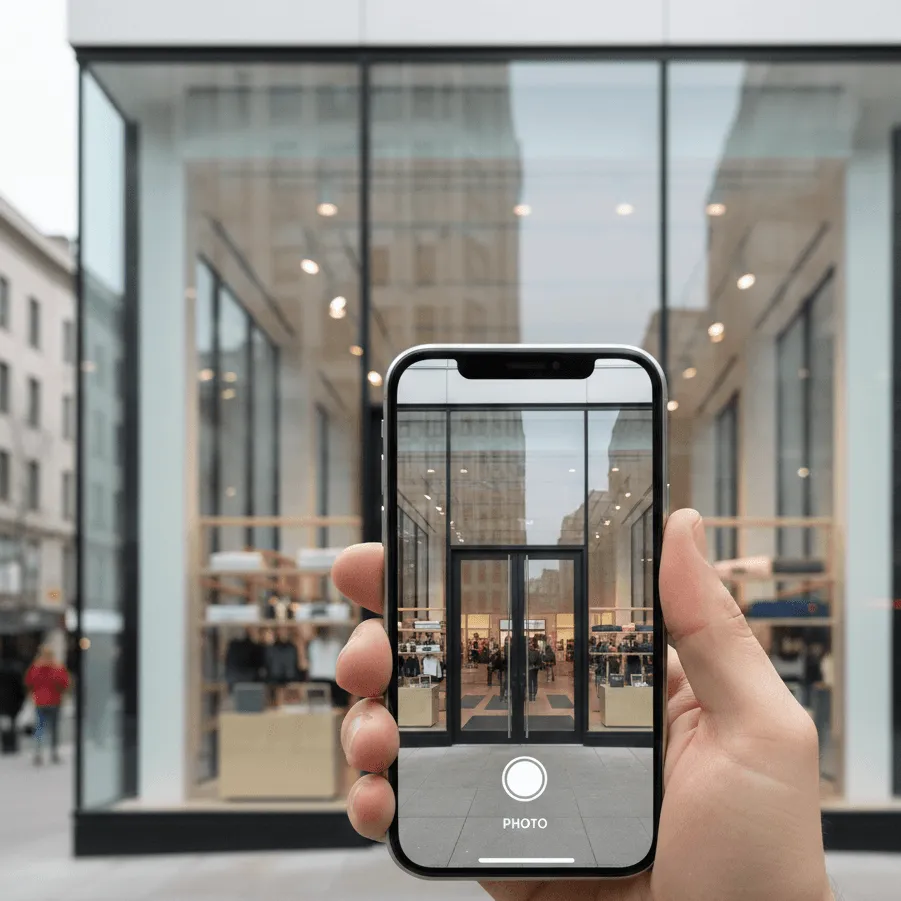
The premise was always right. Customers are bad at reading flat drawings, disputes are almost always about scale and placement, and both problems dissolve if the customer can see the sign on the building. Point a device at the storefront, see the proposed sign in position at the right size, walk around, look from the road. Nothing about that reasoning was wrong.
What held it back was not the tracking technology, which has been good enough for years. It was three practical things.
- The view is trapped on the device. An AR experience exists in the moment, for whoever is holding the phone. Sign decisions are frequently made by someone who was not at the site visit — a business partner, a landlord, a brand manager at head office, a committee that meets on Thursdays.
- Someone has to build the model. A 3D asset of the proposed sign has to exist before it can be placed in a scene. That is design time per job, which puts AR in the same economic bracket as a hand-composited rendering — reserved for the biggest opportunities.
- It often needs an app. Asking a customer to install something adds friction at the precise moment you are trying to remove it.
The result is a technology that demonstrates beautifully and gets used rarely — impressive at a trade show, hard to justify on a Tuesday.
What changed
The shift is that generating a realistic image of a sign on a specific building stopped requiring a designer. That sounds like a smaller claim than AR and it has turned out to be a larger one, because it attacks the cost per mockup rather than the impressiveness of the mockup.
When a visual costs an hour of design time, it is rationed. Only the large jobs get one, revisions are discouraged, and the customer is asked to decide from a description. When it costs seconds, the economics invert: every job gets a visual, revisions stop being something to resist, and the customer iterates in real time instead of waiting for a second appointment.
AR made the demonstration better. Generated mockups made the demonstration cheap. Cheap changed who gets one.
The other quiet advantage is format. A generated mockup is an image. It goes in the proposal, it forwards to the partner who was not there, it survives being looked at next week by someone deciding among three quotes. The live AR view — the more advanced technology — cannot do any of that.
Where accuracy comes from
A generated image is only useful if it represents the sign truthfully, and that depends on measurement rather than on the generation. A mockup scaled from survey dimensions shows the proposed sign at its real size on the real facade. A mockup composed by eye produces the specific failure the technology was supposed to fix: a customer approves an image, the installed sign is correct to specification, and it does not match what they thought they agreed to.
This is why the survey and the mockup belong to the same step rather than being separate tasks. It is also why Vuely generates mockups from the measurements captured during the survey instead of from an uploaded photo alone.
The rest of the signage technology conversation
A quick pass over what else gets grouped under new signage technology, with an honest assessment of each.
Digital and dynamic signage
Genuinely established rather than emerging, and a real revenue line for shops equipped to sell and service it. The constraint is not technological, it is regulatory: digital and animated signage is the most variable category in municipal code and the most likely to be restricted or prohibited outright, with rules on brightness, message hold times, and transitions differing between adjacent jurisdictions. Confirm what is permitted before designing, not after.
Automated sign code lookup
Less discussed and more useful than its profile suggests, because it removes a task nobody enjoys from the critical path. The honest caveat is that any automated tool must be explicit about what it could not verify — a confident-sounding answer assembled from a neighbouring jurisdiction is worse than no answer. How we approach that is a longer discussion.
Measurement from photographs
Improving quickly and useful for reference dimensions that are awkward to reach, but treat it as an assist rather than a replacement for measuring the things a fabrication decision depends on.
On-site e-signature
Unglamorous, and probably the highest ratio of value to novelty on this list. The gap between a customer saying yes and a customer signing is where deals go to die, and closing it requires no new technology at all.
Sign codes change and vary by zoning district and overlay. Confirm with the authority having jurisdiction before submitting a permit.
The test for any new signage technology
One question predicts adoption better than any feature comparison: does it remove a step, or add one?
Technology that removes a step survives contact with a busy month. Generating a mockup from a survey removes a designer’s compositing time. Automated code lookup removes an afternoon of ordinance reading. On-site signature removes a follow-up visit. In each case the rep does less than before, so the change holds under pressure.
Technology that adds a step gets used for three jobs and abandoned — not because anyone decided against it, but because the week got busy and the old way was faster in the moment. Most AR workflows currently sit in this category: build a model, bring the right device, get the customer to install something, and hope the person who actually approves the spend was standing there.
None of that means AR is a dead end. If model generation becomes as cheap as image generation has, the calculation changes, and the AR view will be the natural companion to the shareable image rather than a competitor to it. It just is not the technology to reorganise your sales process around this year.
What to do with this
If you are evaluating signage technology, ignore the demo quality and ask three things: does it remove work from the rep rather than adding it, does its output survive being forwarded to someone who was not there, and is what it produces accurate enough to hand to production.
The tools that pass all three are unglamorous — a structured survey, a scaled mockup, a code check, a signature. They are also the ones that are still in use six months after the trade show.
Frequently Asked Questions
What is AR signage?
Augmented reality signage means viewing a proposed sign overlaid on the real building through a phone or tablet camera, in place and at scale, before it is built. The term is also used for installed signs that trigger an AR experience for the public, which is a marketing application rather than a sales one. In a sign company context it almost always means the first: showing a customer their sign on their building.
Is augmented reality useful for selling signs?
The underlying idea is sound — customers approve faster when they can see the sign in place rather than imagine it. The practical difficulty is that a live AR view exists only on the device holding it up. It cannot be emailed to the partner who was not there, attached to a proposal, or reviewed by a committee, which is where most sign decisions are actually made.
What is the difference between AR signage and an AI mockup?
An AR view is live and ephemeral: the sign appears in the camera feed while you point the device at the building. An AI mockup is a generated image of the sign on a photograph of that building — static, shareable, attachable to a proposal, and reviewable by people who were never on site. AR is the more impressive demonstration; the image is usually the more useful artefact.
How accurate are AI-generated sign mockups?
Accuracy depends on whether the mockup is scaled from real measurements or eyeballed. A mockup generated from survey dimensions represents the proposed sign at its actual size on the actual facade, which is accurate enough to sell from and to hand to production. It remains a sales and approval tool rather than a substitute for engineered drawings.
What signage technology is worth adopting now?
The technologies that remove a step from an existing process rather than adding a new one. Mockups generated from a site survey replace a designer's compositing time. Automated code lookup replaces manual ordinance research. On-site e-signature replaces a follow-up visit. Technologies that require an extra step — including most AR workflows today — tend to be used enthusiastically for a few jobs and then quietly dropped.
Do customers need an app to view a sign mockup?
They should not have to. Anything that requires a customer to install software adds a step at the exact moment you are trying to remove friction. A mockup delivered as an image inside a proposal they can open on any device will be seen by everyone who needs to approve it; an experience requiring an app will be seen by the person you were standing next to.
See Vuely on your own storefront
Site surveys, instant mockups, and ready-to-sign proposals in minutes.