
Channel Letters vs Dimensional Letters: Shop Guide
 Jack KellyCo-Founder, Vuely
Learn the exact technical differences between channel letters and dimensional letters, including cost, installation methods, and electrical permitting.
On this page
What is the exact difference between channel letters vs dimensional letters? Dimensional letters are solid or hollow shapes made without internal lighting, mounted directly to a surface. Channel letters are fabricated, hollow 3D enclosures designed specifically to house internal LED lighting components.
When a client asks for a storefront sign, estimators and project managers must guide them to the right option based on budget, nighttime visibility needs, and building codes. Selling a client on an internally illuminated sign without checking the local municipal code or the landlord sign criteria often leads to rejected permits and wasted design time.
This guide breaks down the core technical differences, cost expectations, installation requirements, and permitting rules for both sign types. It also provides practical talking points to help sign shop owners and estimators explain these differences to clients.
Channel Letters vs Dimensional Letters: Core Differences
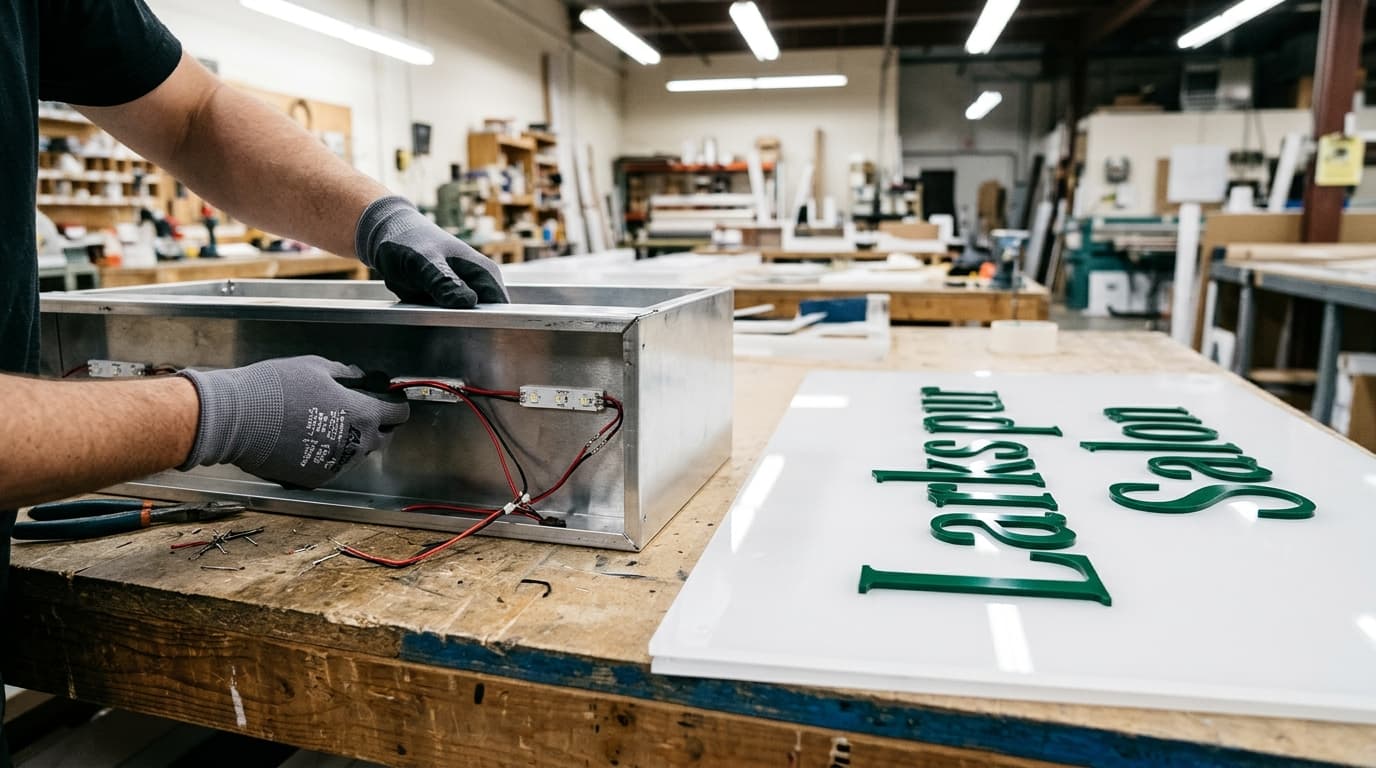
The primary distinction between these two sign types lies in how the letter is constructed and whether it includes integrated illumination. Channel letters are built essentially as individual light boxes. A standard front-lit channel letter features an aluminum backer, metal side walls known as returns, and a translucent acrylic face held in place by a trim cap.
The returns on channel letters usually measure three to five inches deep. This depth is required to allow proper light dispersion from the internal LED modules, ensuring the face lights up evenly without visible hot spots. Other variations include reverse channel letters, which have solid metal faces and clear polycarbonate backs to project light against the wall, creating a halo effect.
Dimensional letters are fundamentally different in construction. They are solid pieces cut from flat sheet material like acrylic, aluminum, or PVC. In some cases, they are cast from metal or vacuum-formed from plastic to create hollow shapes, but they never contain internal lighting components. Their thickness usually ranges from 1/8-inch for flat-cut sheets up to one or two inches for cast metal or thick acrylic.
Nighttime visibility usually dictates the choice for retail and commercial sites. Channel letters offer built-in, highly visible illumination. Dimensional letters rely entirely on external ambient light or dedicated external light sources, such as gooseneck fixtures or ground-level floodlights, to remain visible after dark.
Cost Expectations and Price Scaling
Clients rarely understand why an illuminated sign costs five to ten times more than an unlit sign. Estimators must break down the fabrication labor, material costs, and electrical components involved to justify the price difference.
Benchmarking Dimensional Sign Costs
A standard exterior dimensional letter sign made from flat-cut acrylic, painted PVC, or aluminum typically ranges from $500 to $2,500 installed for a basic wordmark. A CNC router can cut a complete set of dimensional letters in a matter of minutes, requiring minimal assembly labor before painting or finishing.
Benchmarking Channel Letter Costs
A basic front-lit channel letter set for a small retail storefront usually costs $3,000 to $8,000 installed. Complex, multi-color, or dual-lit sets often range from $8,000 to $18,000 or more. Fabrication involves automated channel bending machines, manual assembly of returns to backers, wiring, sealing, and testing.
- Height scaling: Channel letter pricing scales non-linearly. A common shop rule of thumb estimates $150 to $400 per inch of letter height for base fabrication.
- Material density: Increasing a letter from 18 inches to 24 inches drastically increases the required LED module count and power supply capacity.
- Installation variables: Flush-mounted illuminated signs require significantly more on-site labor than unlit signs.
If a client has a tight budget but wants a premium look, you can sometimes pivot them to thick dimensional acrylic or cast metal. Just make sure to clarify the exact methodology for the cost of channel letters early in the conversation. You can refer to our guide on how to price channel letters for a deeper breakdown of estimating these jobs.
Installation and Facade Impact
The method used to attach the sign to the building varies heavily between the two types. This impacts installation time, equipment rentals, and landlord approval processes.
Dimensional letters use simpler mounting methods. Installers typically use threaded studs and silicone, mounting pads, or structural adhesive tape for smaller lightweight letters. This requires fewer holes in the wall, and the penetrations are generally small. On sturdy facades like brick or concrete, installing a dimensional sign is a straightforward drill-and-fill operation.
Channel letter sets require significant facade penetration if they are flush-mounted directly to the wall. Each individual letter requires multiple mechanical anchors to hold the weight, plus a larger hole, usually half an inch or more, for the low-voltage electrical wire to pass through the wall to the power supply inside the building. A ten-letter sign can easily require 30 to 50 individual penetrations.
To reduce wall damage, many landlords dictate raceway mounts in their sign criteria. A raceway is an aluminum box that houses the electrical components and wiring. The letters mount directly to the raceway in the shop. On site, the raceway requires only a few heavy-duty anchors into the building facade, preserving the wall. Before quoting a job, check the landlord approval for tenant signage guidelines to see if raceways or wireways are mandatory.
Wall composition also dictates the installation method. Exterior Insulation and Finish Systems require specialized toggles and standoff tubes for heavy illuminated signs to prevent crushing the foam facade. Dimensional letters put far less stress on fragile wall surfaces.
Electrical Requirements and Permitting
Adding internal illumination triggers strict electrical codes and certification requirements. Dimensional letters bypass this entirely, assuming no external lighting fixtures are included in your scope of work.
Illuminated signs must comply with local safety standards, often governed by NEC Article 600. The signs must carry a UL 48 listing or an equivalent certification to prove they are safe. The sign requires designated power supplies, usually 12V or 24V Class 2 transformers, and an external disconnect switch.
Clear communication about secondary versus primary electrical work prevents project delays. In most jurisdictions, sign installers only run the secondary low-voltage wiring from the letters to the power supply. The client is responsible for hiring a licensed electrician to bring the 120V or 277V primary circuit to the sign location and make the final connection.
This primary electrical hookup is a hidden soft cost for the client. It often adds hundreds or thousands of dollars to their total project budget depending on how far the panel is from the sign. State this exclusion clearly on your proposals. Furthermore, electrical permits are handled separately from standard zoning permits. You can review the sign permit process to understand how to stage these applications.
Explaining the Choice to a Client
When a prospect asks for a lighted sign but has a budget of only $1,500, the estimator has to reset expectations immediately. Start by asking diagnostic questions about their business model, operating hours, and location.
- Ask about operating hours: If the business closes at 5:00 PM and relies on daytime foot traffic, unlit dimensional letters usually make more sense.
- Check the lease: If the property manager strictly prohibits raceways but the building facade cannot support direct wire access behind the letters, a dimensional sign might be the only viable workaround.
- Discuss total cost of ownership: Remind the client that illuminated signs require future maintenance. LED modules eventually fail, power supplies burn out, and acrylic faces require cleaning.
Visualizing the difference helps clients understand the price gap. You can use sign estimating software like Vuely to generate an AI-assisted mockup during the site visit. By taking a photo of their storefront and placing an instant mockup of both a flat dimensional set and an illuminated set, you help the client visualize the difference in depth and impact. Adding tools like this requires a minor software investment, see our pricing, but it prevents wasted design hours on clients who cannot afford the product.
Vuely focuses on closing signage deals instantly with mockups and validating designs against local city codes. It is not shop management or ERP software, but it helps the front office get accurate approvals before production starts.
Frame the conversation around their specific goals. If they are an anchor tenant in a busy shopping center, the investment in internal illumination is non-negotiable for brand visibility. If they are a B2B warehouse in a suburban office park, dimensional letters provide the necessary professional identification at a fraction of the cost.
Sign codes change and vary by zoning district and overlay. Confirm with the authority having jurisdiction before submitting a permit.
Frequently Asked Questions
Can dimensional letters be lit at night without internal wiring?
Yes, dimensional letters can be illuminated using external light sources like gooseneck lamps or ground-mounted floodlights. Because they do not contain internal wiring or LED modules, they are cheaper to fabricate but require outside electrical fixtures to remain visible after dark.
Why are channel letters so much more expensive to install than dimensional letters?
Installing an illuminated sign requires drilling large holes for wiring, mounting heavy power supplies, and wiring low-voltage connections inside the building. Dimensional letters are lightweight and attach quickly with small studs and silicone, requiring zero electrical labor.
What is the difference between reverse channel letters and halo-lit dimensional letters?
Reverse channel letters are hollow metal enclosures that house internal LEDs and push light against the wall. True dimensional letters are solid. If a shop offers halo-lit dimensional letters, they are usually routing a deep pocket into thick solid acrylic to hide LED tape.
Do I need an electrical permit for exterior signage?
Yes. In almost all jurisdictions, installing internally illuminated signs requires a specific electrical permit alongside the standard zoning permit. This ensures the primary voltage hookups, disconnect switches, and power supplies comply with local safety codes.
When does a landlord require a raceway instead of a flush mount?
Landlords require raceways to minimize damage to the building exterior. A flush-mounted sign requires multiple anchor and wire holes for every single letter. A raceway houses all the wiring and requires only a few structural anchor points, preserving the facade.
See Vuely on your own storefront
Site surveys, instant mockups, and ready-to-sign proposals in minutes.