
ERP for Sign Manufacturers: Evaluation Guide
 Jack KellyCo-Founder, Vuely
Learn how to choose an ERP for sign manufacturers. Compare print MIS tools against structural job-shop software for pricing, routing, and field services.
On this page
- What separates print MIS from an ERP for sign manufacturers?
- Handling complex material yields and structural calculations
- Managing the entire project lifecycle
- Financial integration and accounting limits
- Real costs and timeline expectations
- Keeping sales tools separate from complex production
- Frequently Asked Questions
Evaluating an erp for sign manufacturers requires drawing a hard line between print graphics software and structural manufacturing systems. While a basic sign MIS works for flat-sheet and wide-format vinyl, custom architectural and electric sign builders need a true job-shop platform to run their business.
These specialized platforms handle channel letters, pylons, complex multi-level bills of materials, and field installation logistics. If your shop deals with excavation, welding, and bucket trucks, choosing the wrong software leads to stalled implementations and broken workflows.
This guide covers how to assess production modules, understand pricing realities, and match software to the way your estimators and project managers actually work.
What separates print MIS from an ERP for sign manufacturers?
Many shops outgrow spreadsheets and generic CRMs, only to adopt a print MIS that fails to handle custom fabrication. Tools built for wide-format printing focus on square footage and flat materials. They lack the database architecture to manage structural, electrical, and dimensional signage.
- Routing and finishing: A structural ERP tracks complex routing paths, brake-metal fabrication, welding, and subcontracted powder coating alongside standard printing.
- Dynamic yield and scrap: Estimators need systems that calculate sheet goods like ACM, acrylic, and aluminum without requiring manual CAD takeoffs for every bid.
- Multi-level bills of materials: True manufacturing platforms link nested components, linear extrusions, and electrical LED modules into a single parent assembly.
When evaluating evaluating shopVOX alternatives, look closely at how the platform groups tasks. Standard print ERPs fail on outside processing and field installation logistics. If the software treats a set of illuminated channel letters the same as an adhesive banner, your production team will end up reverting to spreadsheets to manage the build.
Handling complex material yields and structural calculations
Flat graphics estimation is simple math based on square footage. Structural sign estimation requires calculating scrap, drop, and linear usage across multiple raw materials. Standard printing software struggles with this requirement.
A structural sign ERP allows estimators to build rules for material consumption. When an estimator enters the dimensions of a pylon sign, the system should automatically calculate the yield for steel pipes, aluminum angle, and acrylic faces.
- Linear extrusions: The software must convert overall sign dimensions into precise cuts for retainers and structural framing.
- LED and power supply limits: Estimators need systems that calculate the number of LED modules required and automatically specify the correct number of power supplies based on wattage limits.
- Scrap utilization: A true manufacturing platform tracks reusable drop material and factors it into inventory, reducing waste and improving profit margins on future jobs.
If your estimators spend hours doing manual CAD takeoffs to determine how many sheets of aluminum a job requires, your software is holding back your sales capacity.
Managing the entire project lifecycle
Custom sign manufacturing extends far beyond the shop floor. An effective ERP must align fabrication schedules with the outside factors that dictate when a project can actually proceed.
Project managers handle artwork proof approvals, engineering sign-offs, and municipal permitting. A platform that only schedules CNC time misses half the project timeline. Commercial sign shops require multi-tiered workflows.
- Permitting delays: The software must track the sign permit process and adjust production start dates automatically if a city rejects an application.
- Landlord approvals: Workflows need hold statuses for external landlord or property management sign-offs to prevent unauthorized manufacturing.
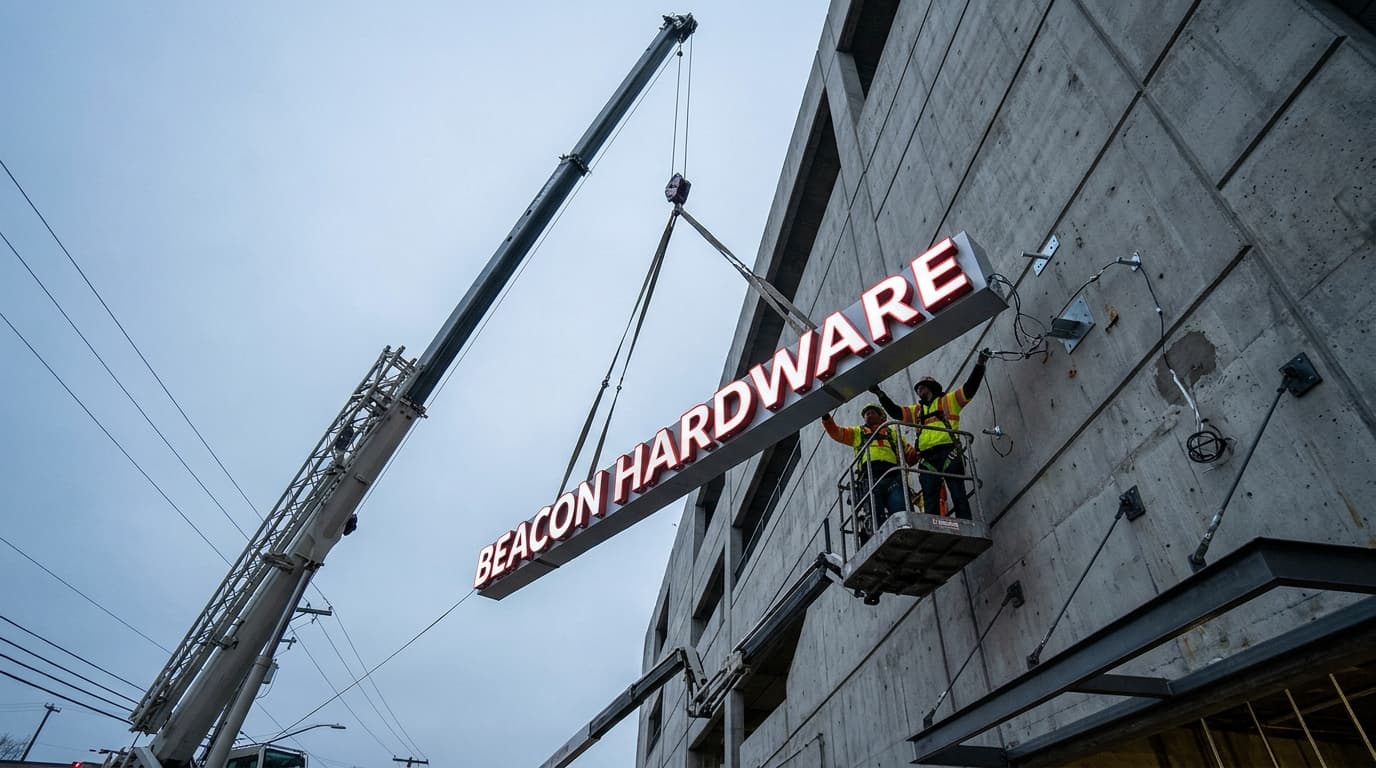
- Field installation logistics: Structural signs require staging, crane or bucket truck scheduling, and field crew dispatch after finishing.
If your software cannot link a bucket truck dispatch to the completion of an electrical assembly, you will constantly battle scheduling conflicts. An ERP must bridge the gap between the fabrication floor and the installation site.
Financial integration and accounting limits
Software vendors often push shops to adopt proprietary accounting modules. Completely replacing your general ledger carries heavy risk and requires careful planning.
Most commercial shops under five million dollars in revenue rely on standard tools like QuickBooks Online or Desktop. At this stage, bi-directional syncing is the baseline requirement. You need an ERP that pushes invoices, material costs, and labor data to your existing accounting system without manual duplicate entry.
As shops pass the ten to fifteen million dollar mark, QuickBooks often becomes unviable due to transaction volume and complexity. At that scale, migrating to an enterprise ERP with a fully integrated general ledger begins to make financial sense. Before committing to a massive accounting migration, verify whether the ERP allows you to keep QuickBooks active during the transition period. A phased rollout protects your cash flow visibility.
Real costs and timeline expectations
Vendors rarely publish flat pricing for custom manufacturing software. Implementation frequently drags out or fails completely because shops underestimate the work required to migrate custom material databases and multi-level bills of materials.
- Entry cloud sign MIS: These tools typically accommodate under 10 users and take four to eight weeks to implement. Base fees start around one hundred dollars per month plus per-user fees.
- Mid-market specialized platforms: Software geared toward mid-sized sign shops generally takes a few months to deploy and costs between a few hundred and over a thousand dollars per month based on user count and modules.
- Enterprise manufacturing ERP: Systems handling massive multi-location rollouts can take six to eighteen months to launch. Software licensing and onboarding fees often range from fifteen thousand to over fifty thousand dollars annually.
To keep the project on track, assign a dedicated internal champion. This person must document standard operating procedures and clean up existing material pricing lists before the vendor starts importing data. Attempting to build a multi-level bill of materials inside a new ERP while guessing at current aluminum prices will stall your deployment for months.
Keeping sales tools separate from complex production
Heavy ERP systems excel at routing, inventory, and long-term scheduling. They are rarely agile enough for a sales rep standing in a parking lot trying to close a deal. Forcing field reps to learn complex back-office software creates friction and slows down the sales cycle.
Many shops separate the front-end sales process from backend manufacturing. Vuely is AI sales software built specifically for sign companies. A rep visits a customer site, captures a guided survey with precise measurements, and the system generates a photo-accurate mockup of the sign on the actual building. It then checks the design against local city sign codes, estimates the price, and collects a signature before the rep leaves.
Once the deal closes, the approved survey data and visual mockup export directly into your manufacturing workflow. Our software is not shop management or ERP software. You can review our pricing to see how it fits into a sales team budget. Keep your front end fast, and let your sign business software handle the heavy lifting of how to price channel letters and route them through fabrication.
Sign codes change and vary by zoning district and overlay. Confirm with the authority having jurisdiction before submitting a permit.
Frequently Asked Questions
What is the difference between a sign MIS and a manufacturing ERP?
A sign MIS focuses on estimating, order entry, and basic workflow tracking for flat goods and printing. A manufacturing ERP handles structural fabrication, multi-level bills of materials, inventory routing, and complex scheduling for custom electrical and architectural signs.
Do we have to replace QuickBooks when adopting an ERP?
Not necessarily. Most cloud MIS and mid-market ERPs offer integration with QuickBooks Online or Desktop. Shops typically only abandon QuickBooks for an integrated ERP general ledger when their revenue exceeds ten to fifteen million dollars and transaction volume demands it.
Why do sign software implementations fail?
Implementations stall when shops lack clean data. Migrating thousands of outdated material costs, unstructured supplier catalogs, and undefined labor rates into a new system overwhelms the team. Success requires a dedicated internal champion to standardize processes before data migration begins.
How does sign software handle complex sheet material yield?
Advanced systems allow estimators to input dimensional variables and apply predefined formulas to calculate scrap and yield for materials like ACM and acrylic. This prevents estimators from spending hours doing manual CAD takeoffs just to build an initial quote.
Can an ERP track city permits and landlord approvals?
Yes. Specialized sign manufacturing platforms include pre-production project management modules. These modules track external milestones like artwork approval, structural engineering sign-offs, and municipal permit statuses to ensure production does not start prematurely.
See Vuely on your own storefront
Site surveys, instant mockups, and ready-to-sign proposals in minutes.