
Vuely vs ChatGPT for Sign Mockups: The Practitioner's Guide
Compare Vuely and ChatGPT for sign mockups. Learn why general AI tools fail at scale and how industry software helps sign shops close deals faster.
On this page
- What Happens When You Ask ChatGPT for a Sign Mockup
- Brand Fidelity and Vector Art Constraints
- Why Scale Destroys General AI Outputs
- Municipal Code Checks and Blind Spots
- The Field Sales Experience: Real-Time vs Delayed Approvals
- Vuely vs ChatGPT for Sign Mockups: Trusting the Workflow
- Frequently Asked Questions
When comparing Vuely vs ChatGPT for sign mockups, the choice comes down to trust and physical accuracy. ChatGPT generates impressive pictures, but it frequently alters building architecture, distorts brand logos, and ignores physical scale constraints. You cannot trust its output for client approval or municipal permitting.
By contrast, industry software anchors mockups to precise site survey measurements, verifies local code compliance, and ties the visual rendering directly to a reliable estimate. This guide explains why general AI fails in the field and how specialized tools protect your sign shop from costly errors.
What Happens When You Ask ChatGPT for a Sign Mockup
Upload a photo of a brick storefront to ChatGPT and ask it to add a channel letter sign. The resulting image might look impressive at first glance. Look closer and you will notice severe problems that make the image unusable for a sign shop. Generative AI models predict patterns based on vast amounts of internet data. They do not understand the physical reality of construction, architecture, or sign fabrication. This lack of understanding leads to multiple distinct failures when attempting to render commercial signage.
- Altered architecture: ChatGPT frequently changes the underlying building structure. It might alter the brick texture, remove a structural beam, or change the roofline to make the composition look balanced. You cannot show a client a rendering that redesigns their physical property.
- Distorted typography: General diffusion models struggle to render exact fonts, kerning, and logo geometry. They produce shapes that resemble letters but fail to match a client's strict brand guidelines.
- Missing physical constraints: The AI has no concept of structural limitations. It will place a heavy cabinet sign across windows or onto decorative trim where mounting is physically impossible.
- Hallucinated lighting: It will add unrealistic glow effects or impossible light sources that misrepresent how a real sign behaves at night.
- Raster approximations: The output is a flat image file. You cannot extract usable dimensions, vector files, or layer data for your production team.
These errors mean general AI creates liability rather than clarity. If a client approves a rendering that shows a sign taking up half the fascia, but physical reality dictates it can only cover ten percent, you have set an expectation you cannot meet. Retracting a promised design damages trust and threatens the sale.
Brand Fidelity and Vector Art Constraints
Corporate clients demand exact adherence to their brand guidelines. A regional franchise expects their specific Pantone colors and exact vector geometry on every building they occupy. Maintaining this consistency is the foundation of commercial sign manufacturing.
ChatGPT cannot process or maintain complex vector files. It interprets text prompts and generates raster pixels. When you ask it to place a known logo on a wall, the AI approximates the shapes based on its training data. The result often features misshapen letters, incorrect character spacing, and wrong color values. For custom local brands with unique logos, the AI will simply invent completely new typography that has no relation to the actual business.
In commercial signage, approximation is unacceptable. Software built for sign makers must preserve the original vector artwork. It needs to place the exact logo file onto the building photo, applying proper perspective and realistic shadows without altering the core geometry. This ensures the client sees their actual brand on the wall, not a computer-generated guess. Maintaining strict brand fidelity prevents immediate rejections from corporate marketing departments.
Why Scale Destroys General AI Outputs
The primary purpose of a mockup is to lower the client's perceived risk regarding scale, lighting, and placement. A mockup only succeeds if the visual representation matches the final installed product. Read more on how visuals impact sales in our AR signage and AI mockups guide.
Generic AI tools treat signs as digital stickers. They guess the size based on visual proportions. In the sign industry, estimating requires hard numbers. A sales rep needs to know exactly how a 36-inch tall cabinet looks on a specific elevation from the street. If an image generator makes the sign look huge on a small building, the customer gets a false impression of what they are buying. When the real, smaller sign gets installed, the customer feels cheated.
Software built for sign company software workflows forces the rendering to obey physical dimensions. When an estimator inputs the exact measurements taken during a site survey, the mockup scales the artwork to those specific constraints. If the sign is too large for the space, the software shows the conflict immediately. This protects the shop from selling an impossible sign and prevents expensive rework downstream.
Municipal Code Checks and Blind Spots
Designing an attractive sign is only part of the process. The design must conform to local municipal sign codes. Every jurisdiction has specific rules governing maximum square footage, setback distances, illumination types, and raceway colors. A design that looks perfect on a screen means nothing if the city rejects the permit application.
ChatGPT has zero awareness of local zoning laws. It will happily generate a massive, exposed-neon roof sign in a historic district that strictly forbids both neon and roof-mounted structures. Trusting these concepts wastes time because the design will fail the permit process. You then have to explain to the client why the impressive sign they approved is illegal.
Purpose-built tools act as a sign code checker by integrating local regulations directly into the mockup process. Before you present a design to a client, the software verifies that the proposed dimensions fall within the legal limits for that specific address. This ensures that the mockup you sell is a mockup you can actually build, install, and permit without delays.
The Field Sales Experience: Real-Time vs Delayed Approvals
The traditional sign sales cycle is notoriously slow. A rep visits the site, takes photos, measures the fascia, and drives back to the shop. The rep hands the notes to a designer, who spends a day or two creating a rendering. The estimator prices the job. Days later, the rep finally emails the proposal to the prospect.
Using a general chatbot does nothing to accelerate this timeline. A rep cannot stand in a parking lot, upload a photo to an AI prompt, and get a reliable, scalable quote to show the customer. The rep still has to wait for shop staff to verify feasibility and calculate costs.
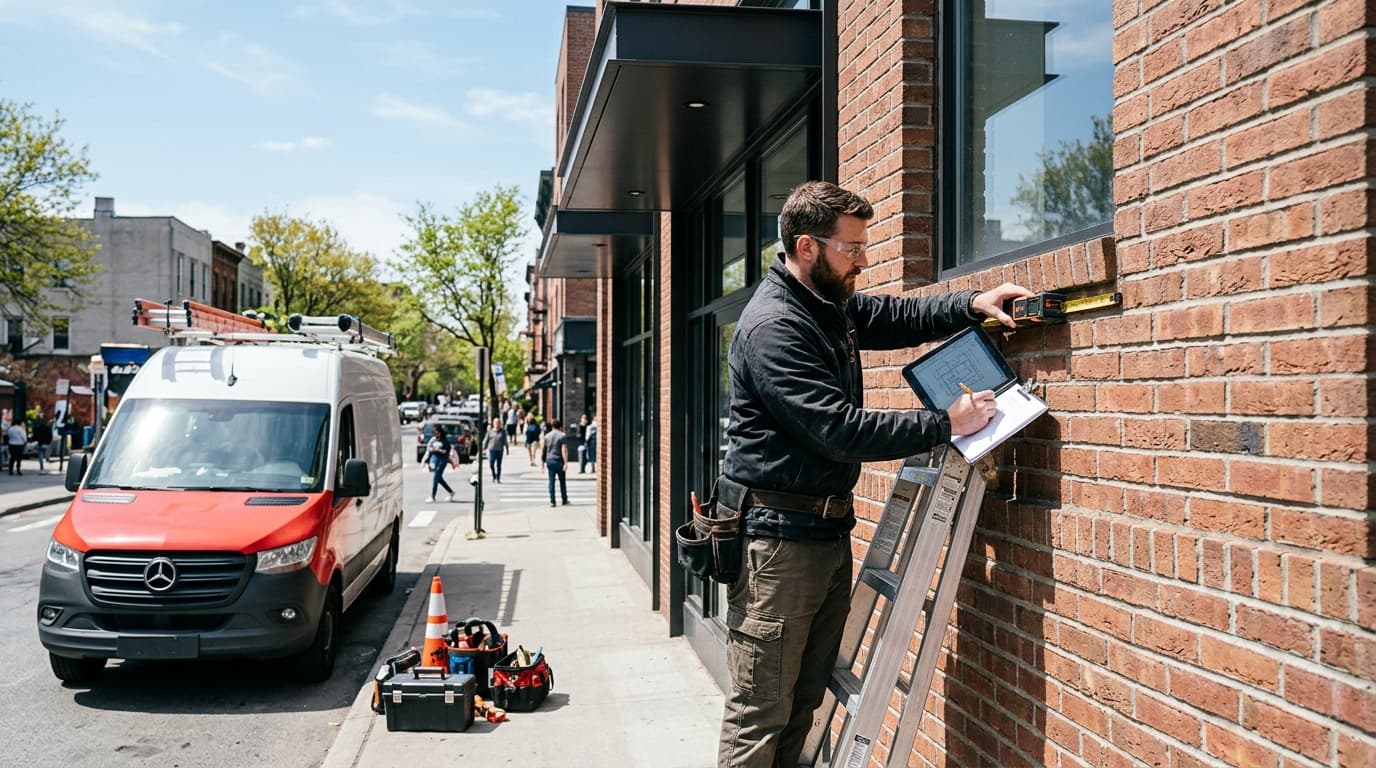
Industry-specific software changes the entire process. A rep uses a guided survey checklist to capture photos and measurements on their phone. The software applies the logo at true scale immediately. The rep can change the sign type from non-illuminated dimensional letters to front-lit channel letters right there on the sidewalk. Because the software ties the visual changes to pricing, the rep hands a tablet to the business owner and collects a signature on site. This method eliminates days of waiting and prevents competitors from swooping in. Learn more about how to close signage deals instantly with mockups.
Vuely vs ChatGPT for Sign Mockups: Trusting the Workflow
The choice between these tools is a choice between a conceptual toy and a field sales engine. ChatGPT provides a generic visual guess. Vuely provides an end-to-end sales workflow that sign professionals can trust to close deals accurately.
- Site survey integration: The software uses guided mobile checklists and exact physical measurements to anchor the project in reality.
- Photo-accurate scaling: Instead of hallucinating building features, it maps the exact design to the actual storefront photo using real-world scale.
- Regulatory compliance: The system checks the design against municipal sign codes so you never pitch an illegal sign.
- Integrated estimates: The mockup informs the pricing, allowing reps to generate one-click proposals.
- System integration: Vuely connects with management platforms like CoreBridge to pass data directly to production.
General AI subscriptions might seem inexpensive initially. Relying on them introduces costly errors and disjointed processes. Sign shops need software that understands fabrication constraints, pricing, and municipal codes. To review the investment required for a true signage workflow tool, visit our pricing page.
Sign codes change and vary by zoning district and overlay. Confirm with the authority having jurisdiction before submitting a permit.
Frequently Asked Questions
Can I upload a storefront photo to ChatGPT and get an accurate channel letter mockup?
No. ChatGPT generates an image that approximates a sign, but it cannot apply exact physical measurements or strict brand vector geometry to a photo. It often alters the underlying building architecture and hallucinates typography. The result is a concept, not an accurate, buildable mockup.
Why does ChatGPT alter the building facade when creating a mockup?
General generative AI models recreate the entire image based on patterns they learned during training. They do not understand the difference between the existing wall and the new sign. Consequently, they change brick textures, remove windows, and alter rooflines to make the image visually appealing.
How do industry-specific mockup tools ensure accurate scale?
Software designed for sign companies uses actual site measurements to govern the mockup. A sales rep inputs the exact height and width of the fascia during the site survey. The software then scales the vector artwork to those physical constraints, ensuring the sign fits the space precisely.
Can ChatGPT check municipal sign codes or generate estimates?
No. ChatGPT lacks access to local municipal zoning laws and sign codes. It also has no connection to sign fabrication costs, labor rates, or material prices. It provides a visual image but leaves the estimator to calculate pricing and verify legality manually.
Do AI mockup tools eliminate the need for production design software?
No. AI mockup tools focus on the sales and approval phase. They help the client visualize the final product on their building to secure a signature. Your shop still requires traditional design software to create the actual production files, router paths, and fabrication blueprints.
See Vuely on your own storefront
Site surveys, instant mockups, and ready-to-sign proposals in minutes.