
How to Leverage AI as a Signage Business
 Jack KellyCo-Founder, Vuely
Learn how to leverage AI as a signage business to speed up estimating, automate site surveys, and close custom sign deals faster.
On this page
To figure out how to leverage AI as a signage business, you need to separate general digital hype from tools built for physical fabrication. You can apply AI right now to automate quoting, generate photo-accurate site mockups, and check local city sign codes without risking costly fabrication errors.
General AI tools will not help you calculate structural wind loads or price out weeding labor. However, specialized software can drastically reduce your estimating backlog and prevent miscommunications between the sales team and the production floor.
This guide covers practical ways owners, estimators, and project managers can apply artificial intelligence to daily operations to eliminate bottlenecks.
The Limits of Off-the-Shelf Generative AI
Standard generative diffusion models fail at commercial sign mockups. Tools like ChatGPT or Midjourney alter existing building architecture, hallucinate letterforms, and ignore scale constraints from physical site surveys.
- Architectural distortion: Off-the-shelf AI modifies the building facade to fit the sign, changing brick patterns or window placements.
- Typography errors: Text generation remains inconsistent in general models, often resulting in misspelled or distorted logos.
- Lack of scale: Diffusion models do not respect physical survey dimensions, making the mockups useless for structural planning.
If you ask a general AI to show a set of illuminated channel letters on a brick wall, it will generate a beautiful image. However, it will likely invent a new brick pattern and ignore the fact that the actual wall has a raceway obstruction. You cannot submit this fantasy rendering for a municipal permit or send it to your fabrication floor. You need an exact representation of the sign on the customer's actual building, constrained by real-world physics. Read more about why general tools fail for physical signs in our guide on AI mockups.
Automating Site Surveys and Client Mockups
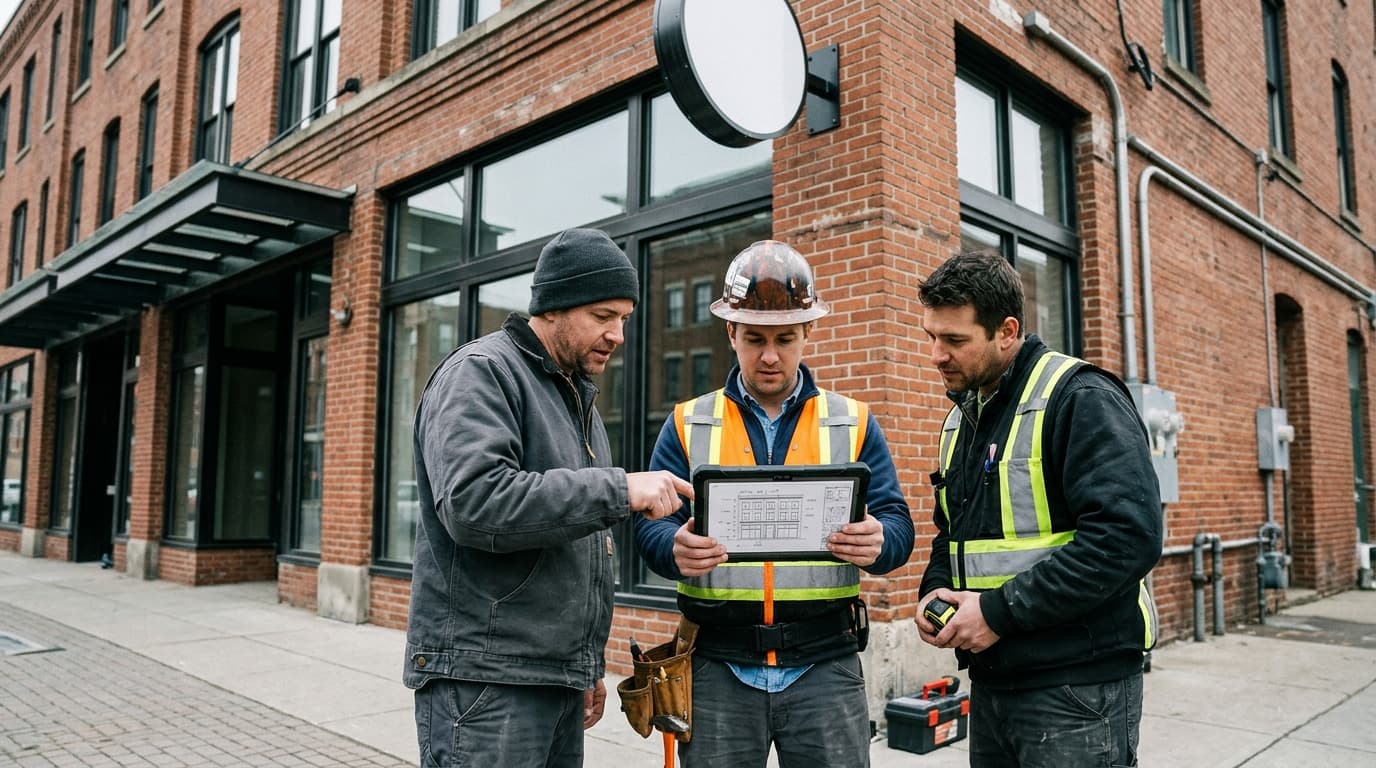
The initial site survey sets the foundation for every custom sign project. Reps often take photos and jot down measurements, then hand the file off to a designer who spends hours building a mockup. This causes immediate bottlenecks.
By implementing specialized sign business software like Vuely, you can eliminate this delay. Vuely acts as an AI assistant built specifically for sign companies. A sales rep uses the app on site to follow guided survey checklists, capture precise measurements, and take photos of the installation area. Vuely then generates an instant, photo-accurate mockup of the proposed sign directly on the customer's building.
- Fast photo capture: Eliminate the need to stitch together multiple low-resolution phone photos.
- AI-assisted scaling: Ensure the digital representation matches the true physical dimensions of the masonry or fascia.
- Unlimited iteration: Adjust the design with the customer standing right next to you.
This process replaces the traditional back-and-forth email chain with the design department, saving hours of internal labor and keeping the client engaged.
Checking City Sign Codes Automatically
Municipal permitting delays are a major bottleneck for project managers. Local regulations vary widely by jurisdiction, dictating allowable square footage, illumination types, and projection distances. Submitting a non-compliant design guarantees rework.
Checking these codes manually requires estimators to dig through dense municipal PDFs for every new address, often resulting in missed details. By automating this process, you protect your profit margins. Vuely checks the design against the local city sign code before you ever present the proposal to the client.
If the city prohibits exposed neon, requires specific setbacks, or limits channel letter height to 24 inches, the software flags the issue immediately. Catching these restrictions on site keeps your pipeline moving and prevents estimators from quoting unbuildable signs.
Estimating Realities and Pricing Math
A typical custom sign estimate takes 15 to 30 minutes to build in a spreadsheet or legacy MIS. Processing 30 inquiries a week consumes up to 20 hours of shop time. Much of this time goes toward bids that never convert.
This administrative burden steals time from high-value tasks. Furthermore, signage fabrication costs do not scale linearly by area. Flat sheet goods are simple, but custom dimensional signs introduce massive variability. Channel letters require you to calculate returns, trim cap, LED modules, power supplies, and raceway mounts. Cut vinyl costs depend heavily on the intricacies of weeding labor rather than basic square footage.
Artificial intelligence helps standardize this math. Vuely handles pricing estimation by connecting your intake data directly to real-world costs. Instead of relying on an experienced estimator to remember the labor multiplier for a complex raceway installation, the software generates accurate pricing based on the AI-verified survey measurements and local code requirements. You can review pricing to see how specialized software pays for itself by recovering lost estimating hours.
How to Leverage AI as a Signage Business for Faster Sales
The core goal of adopting AI is to close deals faster and hand a clean, error-free workflow over to production. Experienced sign project managers command salaries typically between $60,000 and $125,000 a year. You cannot afford to have them wasting time chasing client signatures, fixing structural design errors, or manually re-typing handwritten survey data into an ERP system.
Vuely turns the initial site survey directly into a legally binding contract. Once the rep generates the AI mockup and the software estimates the price, you can present a one-click proposal to the customer right there on the property.
- On-site e-signature: Collect digital approval before the sales rep leaves the site.
- Workflow export: Send the verified dimensions, photos, and compliance data directly to your production team.
- Multiple sign types: Support everything from dimensional letters to pylon faces.
Remember that Vuely is not shop management software, a RIP, or a design service. It is a dedicated intake and sales tool designed to solve the front-end bottleneck so your shop floor receives clean, buildable orders.
Sign codes change and vary by zoning district and overlay. Confirm with the authority having jurisdiction before submitting a permit.
Frequently Asked Questions
Can AI reliably generate a Bill of Materials from architectural plans?
Currently, AI software handles pricing estimation and site mockups better than generating a full Bill of Materials from raw PDFs. Standard AI models struggle with complex fabrication math like nested router sheets and wiring diagrams. Specialized software provides accurate estimates, but production teams still need dedicated ERP systems for final BOM generation.
How do estimators use AI to quote channel letters?
Estimators use AI sales software to capture accurate site measurements and local sign code constraints upfront. The software automatically estimates pricing by factoring in the required materials and labor multipliers for returns, LEDs, and raceways, reducing a 30-minute manual calculation to a few clicks.
Which tools create photorealistic sign mockups without modifying the building?
Vuely generates photo-accurate sign mockups that adhere to exact site survey dimensions. Unlike general tools like Midjourney or ChatGPT that hallucinate architectural elements, Vuely places the proposed design correctly scaled onto the customer's actual building facade.
Does AI integrate with legacy sign shop MIS tools?
Many AI intake tools allow you to export workflow data, measurements, and signed proposals to your existing production software. While AI handles the front-end sales, surveys, and mockups, you still rely on your established MIS tools like ShopVOX or Cyrious Control to manage the physical shop floor.
How can project managers use AI to track municipal permit status?
Project managers use AI to verify designs against local city sign codes before submitting the permit application. Catching dimension or illumination violations early prevents municipal rejections, keeping the project on schedule and avoiding unexpected delays for the field crew.
See Vuely on your own storefront
Site surveys, instant mockups, and ready-to-sign proposals in minutes.